

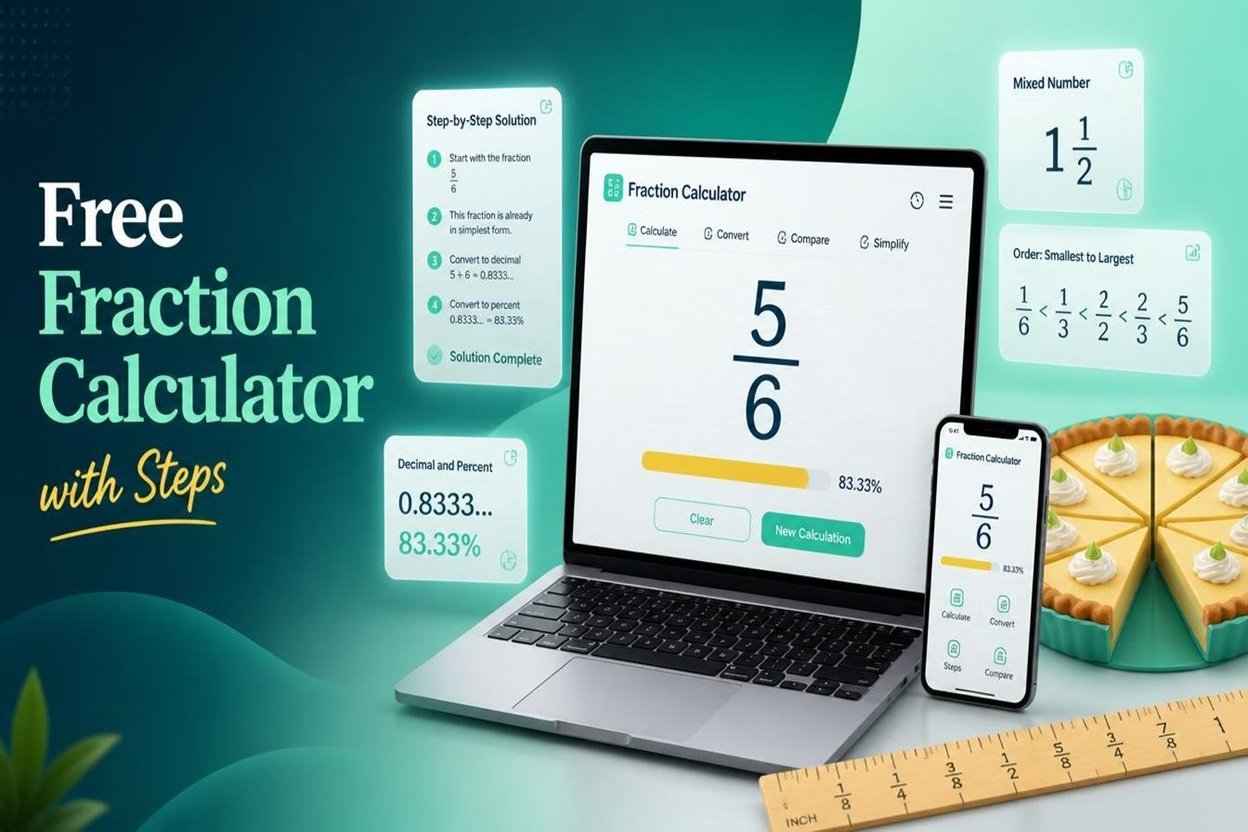
Fraction Calculator
Add, subtract, multiply and divide fractions, mixed numbers and decimals, with every step shown.
Type 3/4, 1 1/2 (mixed), -2.5 or 40%. Multiplication and division run before addition and subtraction.
What Is a Fraction Calculator?
A fraction calculator is an online tool that performs arithmetic on fractions. You can add, subtract, multiply and divide fractions, mixed numbers, whole numbers, decimals and percentages. Unlike a standard calculator, which turns everything into rounded decimals, a fraction calculator keeps your numbers as exact fractions. For example, 1/3 stays 1/3 instead of becoming 0.3333.
Our tool goes further than basic arithmetic. It simplifies results automatically, converts between formats, compares values and finds the greatest common factor and least common multiple, all on one page.
Key Features of Fraction Calculator
- Four operations: Add, subtract, multiply and divide fractions with ease.
- Flexible input: Type 3/4, 1 1/2, -2.5 or 40% in any box. The calculator understands them all.
- Up to six terms: Build longer expressions such as 1/2 + 3/4 × 2/3. The tool follows the correct order of operations.
- Exact results: The answer appears as a simplified fraction, a mixed number, a decimal, a repeating decimal and a percentage.
- Step-by-step solutions: See the common denominator, conversions, simplification and reciprocals explained clearly.
- Visual bar: A colored bar shows how large the fraction is at a glance.
- Compare tool: Sort up to eight values from smallest to largest.
- GCF and LCM finder: Get the greatest common factor and least common multiple, plus prime factorisation.
- Copy and history: Copy any result in one tap and revisit recent calculations.
- Dark mode: Switch between light and dark themes for comfortable use at any hour.
How to Use the Fraction Calculator
Using the tool takes just a few seconds.
To calculate:
- Open the Calculate tab.
- Enter your first value, such as 1 1/2 for one and a half.
- Pick an operation (+, −, ×, ÷) and enter the second value.
- Press Calculate or hit Enter. The result appears instantly.
- Open the step-by-step section to see how the answer was found.
Need more than two numbers? Tap Add term to include up to six values. Multiplication and division are handled before addition and subtraction, exactly as in standard maths.
To simplify or convert: Choose the Simplify & convert tab and enter any fraction, decimal or percentage. You will see the simplest form, the mixed number and the decimal equivalent, along with the greatest common divisor used.
To compare fractions: Open the Compare tab and list your values separated by commas, for example 3/4, 2/3, 0.7, 5/8. The tool sorts them and shows the common denominator it used.
To find GCF and LCM: Use the GCF & LCM tab and enter two to eight whole numbers.
On a phone, use the quick-key buttons for the slash, space, minus, decimal point and percent sign, so you never have to hunt through keyboards.
Worked Example
Say you want to add 1/2 and 1/3.
- The least common denominator of 2 and 3 is 6.
- Rewrite the fractions: 1/2 = 3/6 and 1/3 = 2/6.
- Add the numerators: 3/6 + 2/6 = 5/6.
- Check whether the result simplifies. Here it is already in simplest form.
The calculator shows exactly this reasoning, so the answer teaches you the method as well.
Benefits of Using Our Fraction Calculator
Accuracy you can trust. The tool uses exact arithmetic, so there are no rounding errors, even with large numerators and denominators.
Learning, not just answers. Because every step is displayed, students can check their own working and spot where they went wrong.
Saves time. Finding common denominators and simplifying by hand is slow. Here it takes seconds, which helps in exams revision, homework and daily tasks.
Works on any device. The layout adapts to phones, tablets and desktops. Tabs scroll sideways on small screens and text fields are sized for easy tapping.
Completely free. There is no sign-up and no download. Open the page and start calculating.
Who Is It For?
- Students practising fractions, mixed numbers and decimals.
- Teachers and parents who want clear worked examples to share.
- Cooks and bakers scaling recipes, such as turning 3/4 cup into 1 1/2 cups.
- Builders, carpenters and DIYers adding measurements like 5 3/8 inches and 2 7/16 inches.
- Professionals who need quick, exact figures without opening a spreadsheet.
Tips for Getting the Best Results
- Write mixed numbers with a space between the whole number and the fraction, like 2 3/4.
- Use a minus sign before the value for negatives, such as -1/2.
- Switch the decimal-places selector to 6 or 8 when you need extra precision.
- If a decimal repeats, the tool marks the repeating digits with an underline instead of cutting them off.
- Use the history list to repeat a calculation with small changes.
Final Thoughts
Whether you are checking a homework answer, adjusting a recipe or measuring for a project, a reliable fraction calculator saves time and prevents mistakes. With exact results, clear steps and tools for simplifying, comparing and finding factors, this one covers everything you are likely to need. Try it now and see how simple fractions can be.
Related Tools
Also visit our payoff calculators at: ALL PAYOFF CALCULATORS
Frequently Asked Questions
1. How do I add fractions with different denominators?
Find the least common denominator, rewrite each fraction with it,
then add the numerators.
The calculator does this automatically and shows each step.
2. Can the calculator handle mixed numbers?
Yes. Enter a value like 3 1/4 in any box. The tool converts it to an improper fraction,
calculates, and can show the answer as a mixed number.
3. Does it simplify fractions automatically?
Yes. Every answer is reduced to lowest terms using the greatest common divisor.
The steps tell you which divisor was used.
4. Can I enter decimals or percentages?
Absolutely. Values such as 0.75 or 40% are converted to fractions first,
then used in the calculation.
5. How do I divide fractions?
Dividing by a fraction means multiplying by its reciprocal.
The calculator flips the second fraction and multiplies, showing both steps.
