

Waist to Height Ratio Calculator Pro
Check how your waist measurement compares with your height, a simple indicator of health risk linked to belly fat.
Pro options
Measure your waist at the midpoint between your lowest rib and the top of your hip bone, after breathing out normally. Keep the tape snug but not tight.
Ratio ranges
| Ratio | Category | Meaning |
|---|---|---|
| Below 0.40 | Slim | Waist is small for your height; check you are not underweight. |
| 0.40 to 0.49 | Healthy | Lower risk of weight-related conditions. |
| 0.50 to 0.59 | Increased risk | More central fat; risk rises. |
| 0.60 and above | High risk | Substantially higher risk; speak to a doctor. |
Progress tracker
- No saved results yet.
Frequently asked questions
How is the waist to height ratio calculated?
Divide your waist circumference by your height, using the same unit for both. The simple rule: keep your waist to less than half your height.
Why use this instead of BMI?
BMI does not show where fat is stored. Belly fat is more closely tied to heart disease and type 2 diabetes, and the ratio works for different body builds and heights, which makes it a useful complement to BMI.
Does the ratio differ for men and women?
The same 0.5 boundary is widely used for adults of all genders and many ethnic groups, which is why this tool does not need you to choose one.
Can children use it?
Guidelines apply the same 0.5 boundary to children from about age 5, but growth varies. For anyone under 18, ask a paediatrician to interpret the result.
Introduction | Waist to Height Ratio Calculator
Your weight on the scale does not tell you where your body stores fat. Fat around your middle is linked to a higher risk of heart disease and type 2 diabetes, and one of the simplest ways to check it is the waist to height ratio. Our free waist to height ratio calculator gives you your result in seconds, explains what it means, and shows how to improve it.
What Is the Waist to Height Ratio Calculator?
The waist to height ratio calculator compares your waist circumference with your height. It helps show how much fat you carry around your abdomen, which is the kind most strongly connected to metabolic and heart health.
The guidance is easy to remember: keep your waist to less than half your height. A ratio of 0.5 or lower is generally considered a good target for adults.
How to Calculate Your Waist to Height Ratio
The formula is:
WHtR = waist circumference ÷ height
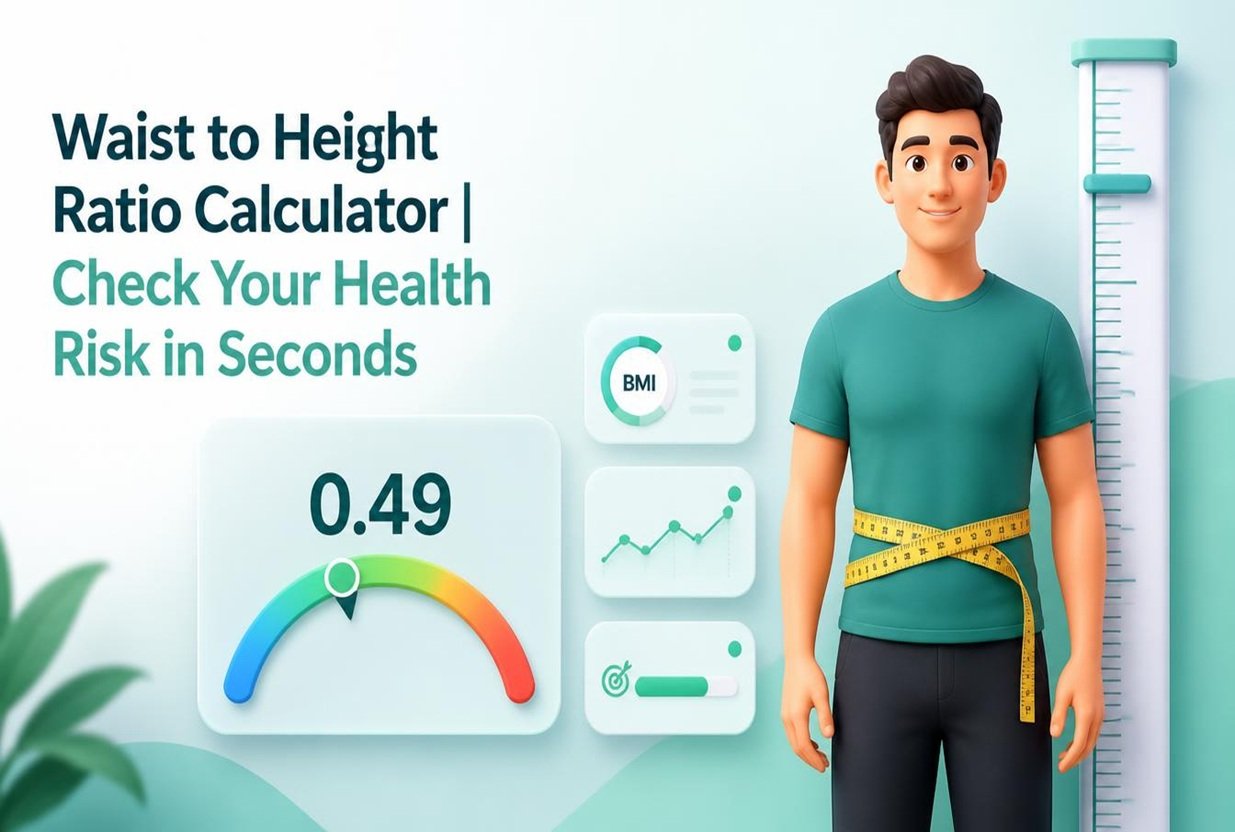
Use the same unit for both. For example, if your waist is 84 cm and your height is 172 cm, your ratio is 84 ÷ 172 = 0.49, which falls in the healthy range. The calculator does this maths for you and handles centimetres, inches, and feet and inches.
Waist to Height Ratio Chart
| Ratio | Category | What it means |
| Below 0.40 | Slim | Check that you are not underweight |
| 0.40 to 0.49 | Healthy | Lower risk of weight-related conditions |
| 0.50 to 0.59 | Increased risk | More central fat, and risk rises |
| 0.60 and above | High risk | Speak to a doctor |
Why Use waist to height ratio calculator Instead of Only BMI?
Body mass index (BMI) is useful, but it has limits. It only uses weight and height, so it cannot tell muscle from fat or show where fat is stored. Two people with the same BMI can have very different amounts of belly fat.
WHtR adds that missing detail. It also uses the same cut-off for most adults regardless of height, which makes it simple to apply. Many health bodies, including the UK’s NICE, now include it in their guidance as a complement to BMI. For the fullest picture, use both, which is why our tool calculates BMI too.
How to Measure Your Waist Correctly
An inaccurate measurement gives an inaccurate result, so take a moment to get it right:
- Stand up straight and relax your stomach.
- Find the midpoint between your lowest rib and the top of your hip bone.
- Wrap a flexible tape measure around your bare waist, snug but not squeezing.
- Breathe out normally, then read the number.
- Measure twice and use the average.
Measure your height without shoes, standing against a wall.
Features of Our Waist to Height Ratio Calculator
This is more than a simple formula box. The Pro options give you a fuller view of your health:
- Metric and imperial units: Switch between cm and inches in one click.
- Colour-coded result and gauge: See at a glance where your ratio sits.
- Target waist size: Find out how much to reduce or increase your waist to reach the healthy range.
- BMI calculation: Add your weight to see your BMI and category.
- Waist to hip ratio: Add your hip measurement and compare it with standard limits for men and women.
- Waist limits by sex: See how your waist compares with commonly used risk thresholds.
- Goal planner: Choose a gentle, steady or faster pace and get an estimated timeline to reach a ratio of 0.49.
- Progress tracker: The last 10 results are saved in your browser with a trend chart.
- Export, copy and print: Download your history as a CSV file, copy your result or print it.
Your measurements stay in your own browser and are not sent anywhere.
How to Lower Your Waist to Height Ratio
If your result is above 0.5, small and steady changes can help:
- Aim for gradual change. A loss of around 0.5 to 1 kg a week is more sustainable than crash dieting.
- Eat more fibre and protein. Vegetables, pulses, lean protein and whole grains keep you fuller for longer.
- Cut back on sugary drinks and ultra-processed snacks.
- Move every day. Aim for about 150 minutes of moderate activity a week, and add two strength sessions.
- Sleep well and manage stress. Poor sleep and high stress are both linked to extra abdominal fat.
- Re-measure monthly. Use the progress tracker to see your trend rather than reacting to one reading.
Who Should Interpret Results With Care?
The ratio is a screening tool, not a diagnosis. It may be less reliable for pregnant women, very muscular athletes, people with certain medical conditions, and children, whose bodies are still growing. If your result is in the increased or high-risk range, or you have any health concerns, talk to a doctor or other healthcare professional.
Try the Calculator Now | waist to height ratio calculator
Knowing your number is the first step towards a healthier waistline. Enter your waist and height above to get your waist to height ratio, then explore the Pro options for BMI, waist to hip ratio, and a personal goal plan. Come back every few weeks to track your progress.
This calculator is for general information and is not medical advice.
Related Tools
Also visit our payoff calculators at: All Payoff Calculators
Frequently Asked Questions | waist to height ratio calculator
1. What is a good waist to height ratio?
For most adults, a ratio between 0.40 and 0.49 is considered healthy. The key rule is to keep your waist below half your height, so a ratio under 0.5.
2. Is waist to height ratio better than BMI?
It answers a different question. BMI looks at weight for height, while WHtR shows how much fat sits around your middle, which is closely tied to health risk. Using both together gives the most useful picture.
3. Is the ratio the same for men and women?
Yes. The same 0.5 boundary is widely used for adult men and women, so you do not need to choose a sex to get your ratio. Our Pro options let you add it for extra waist and waist to hip comparisons.
4. Can children use a waist to height ratio calculator?
Guidelines apply the same 0.5 boundary to children from about age 5, but growth changes body shape. For anyone under 18, ask a paediatrician to interpret the result.
5. How often should I check my waist to height ratio?
Measuring every two to four weeks is enough. Changes in waist size are gradual, and checking too often can be discouraging. Use the progress tracker to follow the trend over time.
