

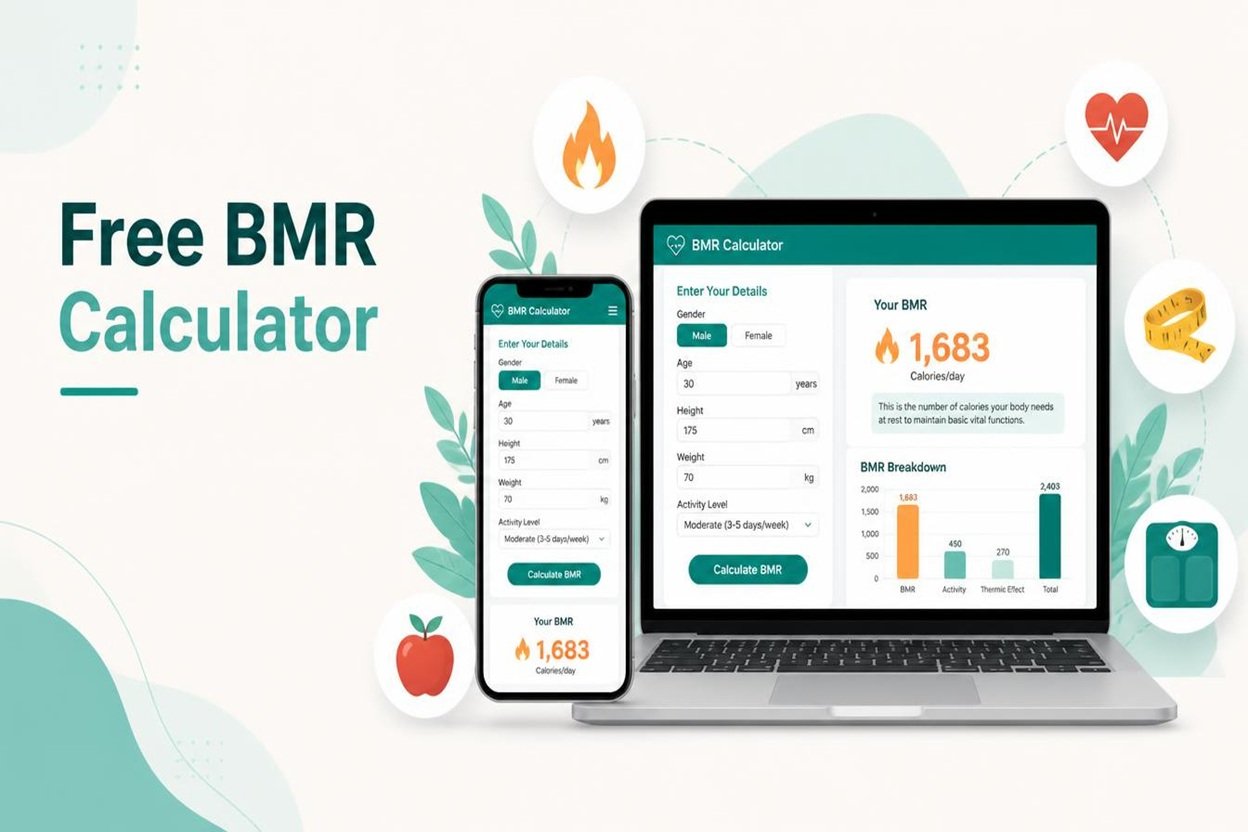
BMR Calculator
Find out how many calories your body burns at rest, then see your daily calorie needs for weight loss, maintenance or gain.
Your daily calorie needs (TDEE)
Maintenance calories based on your selected activity level:
Calories by activity level
| Activity level | Multiplier | Calories/day |
|---|
Your BMR in other units
Tips for your result
About BMR
What is BMR?
Basal Metabolic Rate is the number of calories your body needs to keep you alive at rest: breathing, circulating blood, growing and repairing cells, and regulating temperature. It typically accounts for 60–70% of the calories you burn each day.
Which formula should I choose?
Mifflin-St Jeor is generally considered the most accurate for the general population. Revised Harris-Benedict is an older alternative. Katch-McArdle uses lean body mass, so it suits people who know their body fat percentage, such as athletes.
What is the difference between BMR and TDEE?
BMR is what you burn at rest. TDEE (Total Daily Energy Expenditure) adds the calories burned through movement, exercise and digestion. TDEE is the number to use when planning how much to eat.
Why does BMR change over time?
BMR falls with age as muscle mass declines, rises with more muscle and body size, and is usually higher in men. Crash dieting can lower it, which is why steady changes work better.
Free BMR Calculator
Every day, your body burns calories just to keep you alive, even if you spend the whole day on the couch. Your heart beats, your lungs work, your cells repair themselves, and your body holds its temperature steady. The energy this takes is your Basal Metabolic Rate (BMR).
Knowing your BMR is the first step to eating the right amount for your goals, whether you want to lose weight, build muscle or simply stay where you are. Our free BMR Calculator does the maths for you in seconds. This guide explains what BMR is, how it is calculated, and how to use your result.
What Is BMR?
BMR is the number of calories your body needs at complete rest to carry out its basic life-sustaining functions. These include:
- Breathing and blood circulation
- Brain and nerve activity
- Cell growth and repair
- Hormone production
- Keeping your body temperature stable
BMR typically makes up about 60–70% of the calories you burn each day. The rest comes from movement, exercise and digesting food.
BMR vs TDEE: What Is the Difference?
People often mix up these two terms, but they are not the same.
| Term | Meaning | Use it for |
| BMR | Calories burned at complete rest | Understanding your baseline |
| TDEE | Total Daily Energy Expenditure: BMR plus activity | Planning how much to eat |
To get your TDEE, your BMR is multiplied by an activity factor. That is why our calculator asks for your activity level. Your TDEE is the number you should actually use when setting a calorie target.
Why Should You Calculate Your BMR?
- Lose weight safely. You need to know your baseline before you can set a sensible calorie deficit.
- Gain weight or muscle. A surplus only works if you know what maintenance looks like.
- Avoid under-eating. Eating far below your BMR for long periods can cost you muscle and energy.
- Track progress. Your BMR changes as your weight, age and body composition change.
- Plan meals with confidence. You get a clear number to work from instead of guessing.
BMR Formulas Explained
There is more than one way to estimate BMR. Our calculator lets you choose between three well-known formulas.
Mifflin-St Jeor (recommended)
Developed in 1990, this is widely considered the most accurate formula for the general population. It is the default in our tool.
- Men: BMR = (10 × weight in kg) + (6.25 × height in cm) − (5 × age) + 5
- Women: BMR = (10 × weight in kg) + (6.25 × height in cm) − (5 × age) − 161
Revised Harris-Benedict
An older equation, updated in 1984. It is still popular and tends to give slightly higher results than Mifflin-St Jeor.
- Men: BMR = 88.362 + (13.397 × weight in kg) + (4.799 × height in cm) − (5.677 × age)
- Women: BMR = 447.593 + (9.247 × weight in kg) + (3.098 × height in cm) − (4.330 × age)
Katch-McArdle
This formula uses lean body mass instead of total weight, so it needs your body fat percentage. It can be more accurate for athletes and very muscular or very lean people.
- BMR = 370 + (21.6 × lean body mass in kg)
How to Use the BMR Calculator
- Choose your units. Switch between metric (kg, cm) and imperial (lb, feet and inches).
- Select your gender and enter your age.
- Enter your weight and height.
- Pick your activity level, from sedentary to extra active.
- Choose a formula. If you know your body fat percentage, you can use Katch-McArdle.
- Click Calculate BMR to see your results.
What You Will See
- Your BMR in calories per day
- Your TDEE (maintenance calories)
- Daily calorie targets for losing, maintaining and gaining weight
- A table of calories for every activity level
- Your BMR per hour, in kilojoules and per kg of body weight
- Personalised tips based on your result
You can also copy or print your results to keep for later.
Understanding Your Activity Level
Choosing the right activity level matters. Most people overestimate it, which leads to eating more than they need.
| Activity level | Description | Multiplier |
| Sedentary | Little or no exercise | 1.2 |
| Light | Exercise 1–3 days a week | 1.375 |
| Moderate | Exercise 3–5 days a week | 1.55 |
| Very active | Exercise 6–7 days a week | 1.725 |
| Extra active | Hard training or a physically demanding job | 1.9 |
If you are unsure, pick the lower option and adjust after a few weeks of tracking your results.
How to Use Your Results
To lose weight
Eat about 500 calories below your TDEE. This usually leads to a loss of around 0.5 kg (1 lb) per week. Avoid going below roughly 1,200 calories a day for women or 1,500 for men without professional guidance.
To maintain weight
Eat close to your TDEE. Check your weight every couple of weeks, and adjust if it drifts up or down.
To gain weight or build muscle
Eat about 250–500 calories above your TDEE and combine it with strength training and enough protein.
What Affects Your BMR?
- Age. BMR drops with age, mainly because muscle mass declines.
- Gender. Men usually have a higher BMR because they tend to carry more muscle.
- Body size. Larger bodies need more energy.
- Muscle mass. Muscle burns more calories at rest than fat.
- Genetics. Some people naturally burn more or fewer calories.
- Hormones. Thyroid conditions can raise or lower BMR significantly.
- Dieting. Severe calorie restriction can lower your BMR over time.
8 Tips to Support a Healthy Metabolism
- Eat enough protein. Aim for roughly 1.2–2.0 g per kg of body weight. It helps preserve muscle and takes more energy to digest.
- Lift weights. Strength training two to three times a week builds muscle and raises your resting burn.
- Avoid crash diets. Keep your deficit moderate, around 10–20% below TDEE.
- Sleep 7–9 hours. Poor sleep disrupts hunger hormones and makes weight control harder.
- Stay hydrated. Water supports normal metabolic function.
- Move throughout the day. Walking, taking the stairs and standing more all add up.
- Do not skip meals out of habit. Regular, balanced meals make it easier to meet your needs.
- Recalculate regularly. Update your numbers after every 5 kg (10 lb) of weight change or if your activity changes.
How Accurate Is a BMR Calculator?
BMR calculators give an estimate, not an exact measurement. Most formulas are accurate to within about 10% for healthy adults. Individual differences in genetics, body composition and health can push your real number higher or lower.
The best approach is to treat your result as a starting point. Follow it for two to three weeks, track your weight, and adjust your calories based on what actually happens.
Final Thoughts | BMR Calculator
Your BMR is the foundation of any sensible nutrition plan. Once you know how many calories your body burns at rest, and how activity adds to that, you can set realistic targets and make steady progress without guesswork.
Try the BMR Calculator above, find your numbers, and use the tips in this guide to put them to work.
Related Tools
Also visit our payoff tools at: All Payoff Calculator
Disclaimer: This article and calculator are for general information only and are not medical advice. Please consult a healthcare professional before making significant changes to your diet or exercise routine.
Frequently Asked Questions | BMR Calculator
What is a good BMR?
There is no single good BMR. It depends on your age, gender, height, weight and body composition. An average adult woman has a BMR of roughly 1,300–1,500 calories, and an average adult man roughly 1,600–1,800.
Can I eat below my BMR to lose weight?
It is generally not recommended. Eating well below your BMR for a long time can lead to muscle loss, fatigue and nutrient deficiencies. A moderate deficit below your TDEE is safer and easier to sustain.
Does BMR change with weight loss?
Yes. As you lose weight, your body needs fewer calories, so your BMR drops. Recalculate periodically to keep your targets accurate.
Is BMR the same as RMR?
They are very similar. BMR is measured under strict resting conditions, while Resting Metabolic Rate (RMR) is measured under more relaxed conditions and is usually slightly higher. For everyday planning, the difference is small.
Can I increase my BMR?
Yes, to a degree. Building muscle through resistance training is the most reliable way. Eating enough protein, sleeping well and avoiding extreme dieting also help.
Is this calculator suitable for children or pregnant women?
No. The formulas are designed for healthy adults. Children, teenagers, pregnant or breastfeeding women, and people with medical conditions should speak to a doctor or registered dietitian.
