

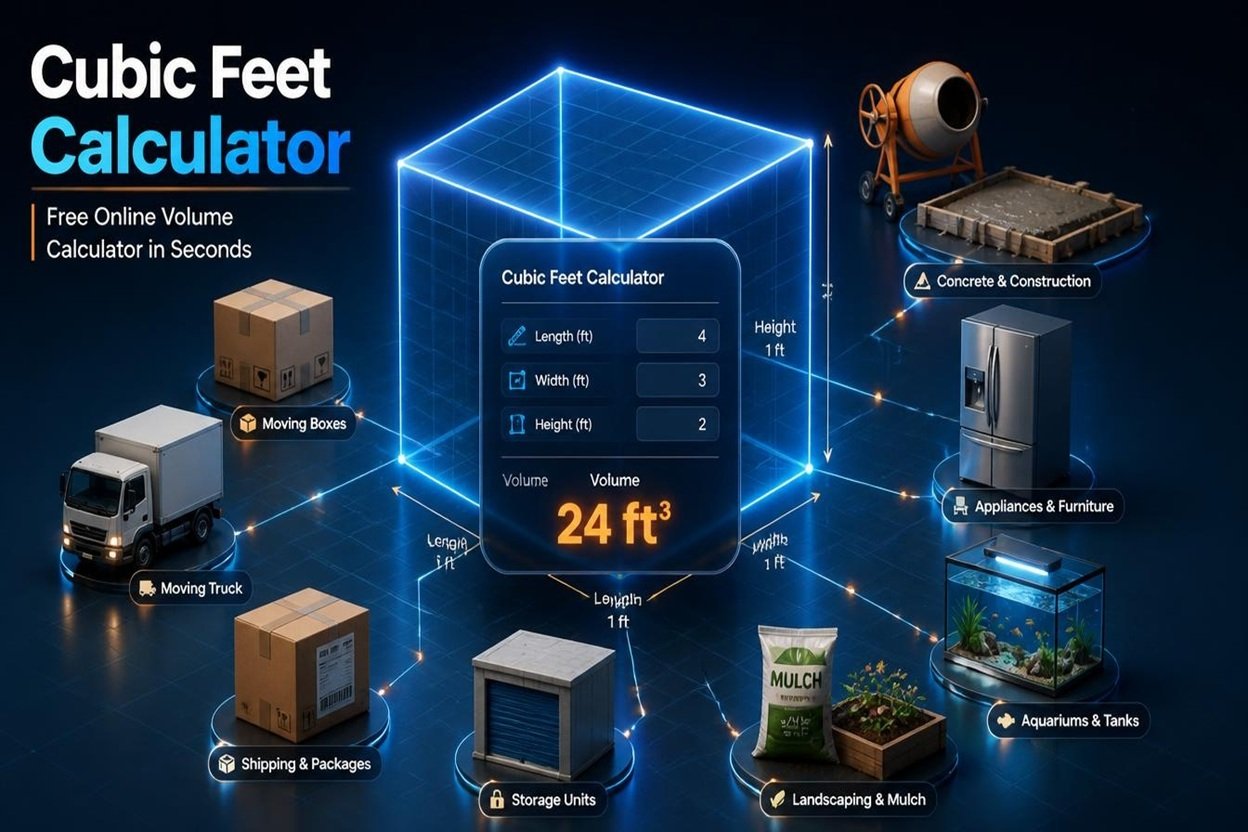
Cubic Feet Calculator
Work out the volume of a box, cylinder, sphere, cone, prism or pipe. Results convert instantly to cubic inches, yards, metres, litres and gallons, with tools for materials, shipping and moving space.
Useful for soil, mulch, gravel, sand, concrete and insulation. Buy a little extra to cover spillage and uneven ground.
Carriers charge the larger of actual and dimensional weight. Check your carrier’s current divisor before quoting a price.
Capacities are approximate interior volumes and vary by provider. Packing gaps mean you should plan on filling about 80–85% of the total.
Quick reference: 1 ft³ = 1,728 in³ = 0.0370 yd³ = 0.0283 m³ = 28.317 litres. To get cubic feet of a box, multiply length × width × height in feet. If your sizes are in inches, divide the result by 1,728.
Stop Guessing Space: Use Our Free Cubic Feet Calculator
Whether you’re booking a moving truck, shipping a package, buying mulch, or sizing a storage unit, one number keeps coming up: Cubic Feet Calculator. Get it wrong, and you can overpay for freight, run short on materials, or watch your furniture refuse to fit.
Our cubic feet calculator removes the guesswork. Enter your length, width, and height to get an accurate volume right away, no formulas to remember, no manual conversions, and no sign-up.
What Is a Cubic Foot?
A cubic foot is a unit of volume. It equals the space inside a cube that measures 1 foot long, 1 foot wide, and 1 foot high. It is the standard way to measure capacity in the United States for refrigerators, freezers, shipping cartons, moving trucks, storage units, soil, concrete, and more.
Quick reference:
- 1 cubic foot = 1,728 cubic inches
- 1 cubic foot ≈ 0.0283 cubic meters
- 1 cubic foot ≈ 7.48 US gallons
- 1 cubic yard = 27 cubic feet
The Cubic Feet Formula
For any rectangular space or object, the formula is simple:
Volume (ft³) = Length (ft) × Width (ft) × Height (ft)
Example: A box that is 4 ft long, 3 ft wide, and 2 ft high has a volume of 4 × 3 × 2 = 24 cubic feet.
If your measurements are in inches, multiply them together and divide by 1,728. For example, a box measuring 24″ × 18″ × 12″ gives 5,184 ÷ 1,728 = 3 cubic feet.
Cubic Feet Calculator does all of this automatically, whichever unit you prefer.
How to Use the Cubic Feet Calculator
- Measure the length, width, and height of your object or space.
- Enter the three values into the calculator.
- Select your unit: inches, feet, yards, centimeters, or meters.
- Get your result in cubic feet, along with other useful volume units.
For the most accurate result, measure at the widest points and round up slightly if you are ordering materials or booking space.
Key Features of Cubic Feet Calculator
- Instant results: the answer updates as you type.
- Multiple units: convert between inches, feet, yards, centimeters, and meters.
- Quantity support: calculate the total volume of several identical boxes or items at once.
- Multiple conversions: see cubic inches, cubic yards, cubic meters, and gallons alongside cubic feet.
- Mobile-friendly: works smoothly on phones, tablets, and desktops.
- 100% free: no downloads, no registration, unlimited use.
Where a Cubic Feet Calculator Comes in Handy
1. Moving and Relocation
Moving companies and truck rentals price and size loads by volume. Adding up the cubic feet of your boxes and furniture helps you choose the right truck and avoid paying for space you don’t need.
2. Shipping and Freight
Carriers often charge by dimensional weight, which is based on package size. Knowing a package’s cubic feet helps you estimate shipping cost and choose the best box.
3. Storage Units
Storage facilities rent by floor area, but what you actually need to know is whether your belongings will fit. Calculating total volume tells you which unit size to book.
4. Gardening and Landscaping
Mulch, topsoil, compost, and gravel are often sold by the cubic foot or cubic yard. Calculate your garden bed or planter volume to buy the right amount the first time.
5. Construction and Concrete
Planning a slab, footing, or post hole? Cubic feet tell you how much concrete or fill you need, which saves both money and trips to the hardware store.
6. Appliances and Furniture
Refrigerators, freezers, and chests are rated in cubic feet of capacity. Measuring the available space helps you pick one that fits your kitchen and your family.
7. Aquariums, HVAC, and Room Planning
Room volume matters for heating and cooling capacity, ventilation, and air purifier sizing. Tank volume helps you plan water and equipment.
Cubic Feet vs. Square Feet: What’s the Difference?
People often confuse the two.
- Square feet measure area, which is flat, two-dimensional space (length × width). Think flooring or paint coverage.
- Cubic feet measure volume, which is three-dimensional space (length × width × height). Think capacity, storage, or how much a container holds.
If you are filling or loading something, you need cubic feet. If you are covering a surface, you need square feet.
Tips for Accurate Volume Measurements
- Use a reliable tape measure and measure each side twice.
- Keep all measurements in the same unit before multiplying, or let the calculator convert for you.
- For irregular shapes, split the object into smaller rectangles, calculate each one, and add the results.
- Add 5–10% extra when buying materials like soil or concrete to allow for waste and settling.
- For packing, remember that boxes never fill perfectly, so leave a little breathing room.
Why Choose Our Cubic Feet Calculator?
There are plenty of volume calculators out there, but ours is built for speed and simplicity. It has a clean layout, accurate results, and no clutter, so you can get your answer and get back to your project. Bookmark it, because you will find yourself using it again.
Final Thoughts | Cubic Feet Calculator
From packing boxes to pouring concrete, knowing your volume saves time, money, and stress. Our cubic feet calculator makes it easy: enter your measurements, get your answer, and plan with confidence.
Try the calculator now and measure your space the smart way.
Related Tools
Also visit our website for a payoff calculator at: All Payoff Calculators
Frequently Asked Questions (FAQ)
How do you calculate cubic feet?
Multiply the length, width, and height of the space or object, all in feet. For example, 5 ft × 4 ft × 3 ft = 60 cubic feet. If you measure in inches, multiply the three numbers and divide by 1,728.
How many cubic feet are in a cubic yard?
There are 27 cubic feet in one cubic yard, because 3 ft × 3 ft × 3 ft = 27 ft³.
How do I convert cubic inches to cubic feet?
Divide the number of cubic inches by 1,728. For example, 3,456 cubic inches ÷ 1,728 = 2 cubic feet.
How do I convert cubic meters to cubic feet?
Multiply the cubic meters by about 35.315. So 2 cubic meters is roughly 70.63 cubic feet.
How many gallons are in a cubic foot?
One cubic foot holds about 7.48 US gallons of liquid.
How do I calculate the cubic feet of a room?
Measure the room’s length, width, and ceiling height in feet, then multiply them together. A room that is 12 ft × 10 ft with an 8 ft ceiling has 12 × 10 × 8 = 960 cubic feet.
Can I calculate cubic feet for a cylinder or a round object?
Yes, but the formula changes: Volume = π × radius² × height. Measure the radius and height in feet, then multiply. Our calculator is designed for rectangular volumes, so for round objects, you can use this formula by hand.
