

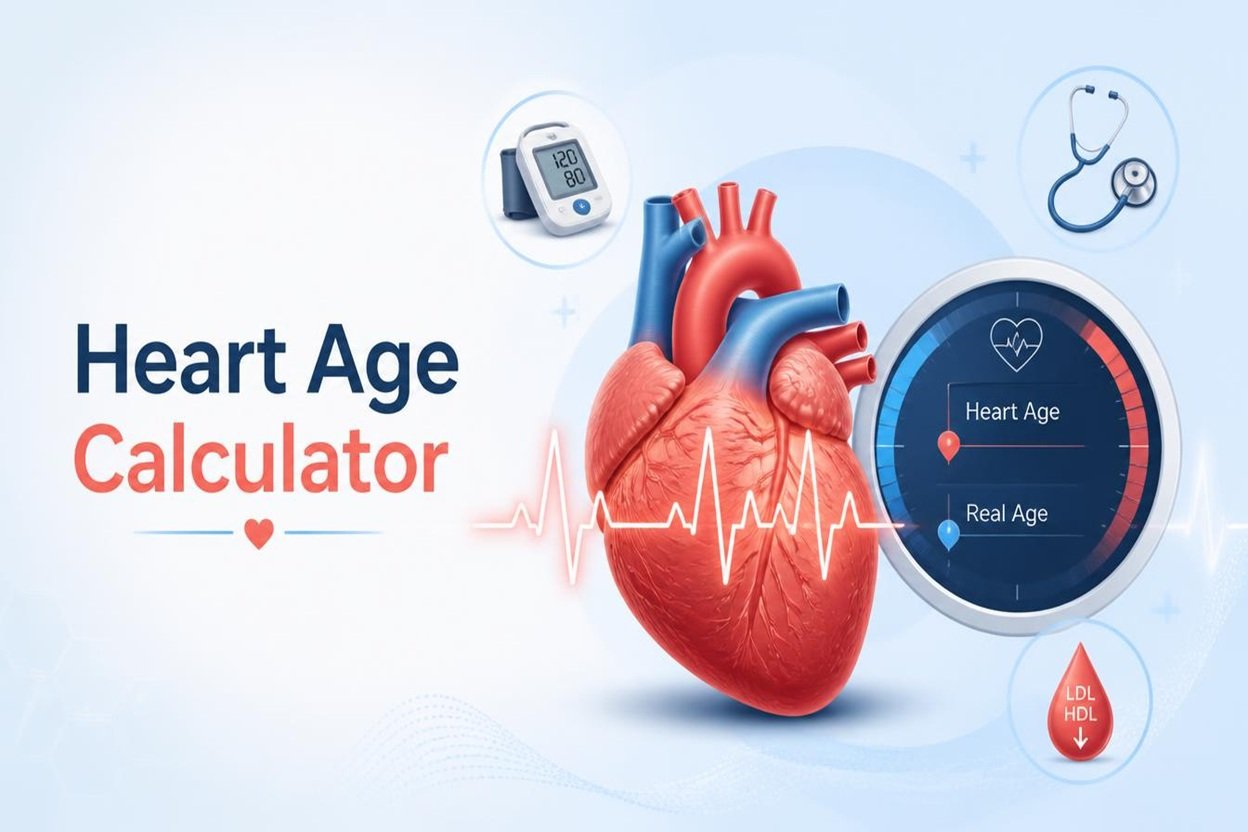
Heart Age Calculator
Find out how your cardiovascular health compares with your real age.
Your details
Enter your details and select Calculate heart age to see your result.
For education only. This tool uses the Framingham general cardiovascular risk equations, which apply to adults aged 30 to 79 with no known heart disease. It is not a diagnosis. Please talk to a doctor about your results and before making health decisions.
Heart Age Calculator
Your birth certificate shows how many years you have lived. A heart age calculator shows something different: how old your heart and blood vessels behave, based on your health numbers and habits. If your heart age is higher than your real age, your risk of a heart attack or stroke may be higher than it should be. The good news is that you can often lower your heart age. This guide explains how a heart age calculator works, how to read your result, and what you can do next.
What Is Heart Age?
Heart age estimates how old your cardiovascular system is. It compares your risk of heart attack or stroke with the risk of a healthy person of the same sex. For example, a 45-year-old who smokes and has high blood pressure may carry the same risk as a healthy 58-year-old. In that case, their heart age is 58.
Heart age is easier to grasp than a percentage. “My heart is 13 years older than I am” is more memorable than “my 10-year risk is 9%”, which makes it a useful prompt to act.
How Does a Heart Age Calculator Work?
A heart age calculator uses a statistical risk model built from long-term studies of thousands of adults. Many calculators, including ours, use the Framingham cardiovascular risk equations. The process has three steps:
- You enter your details: age, sex, cholesterol, blood pressure, smoking status and diabetes status.
- The tool estimates your 10-year risk of a major cardiovascular event, such as a heart attack or stroke.
- It finds your heart age: the age at which a healthy person with ideal readings would have the same risk.
The model is designed for adults aged 30 to 79 who have not already been diagnosed with heart disease.
What You Need Before You Start
Gather these details for the most accurate result:
- Your age and sex
- Total cholesterol and HDL (“good”) cholesterol from a recent lab report
- Your systolic blood pressure, the top number in a reading such as 120/80
- Whether you smoke, have diabetes, or take blood pressure medicine
If you do not know your blood pressure, many pharmacies and health centres can measure it in a few minutes.
How to Read Your Heart Age Result
- Same as or younger than your age: your risk factors look favourable. Keep up your healthy habits.
- One to five years older: the gap is small, which makes this the ideal time to make changes.
- More than five years older: your risk is noticeably higher than average for your age. Book a check-up and discuss your numbers with a doctor.
The calculator also shows your estimated 10-year risk. Common cut-offs describe under 10% as lower, 10% to 20% as moderate, and above 20% as higher, although guidelines vary by country. Remember that a calculator is a screening tool, not a diagnosis.
Six Factors That Can Raise Your Heart Age
1. High blood pressure. It often causes no symptoms, yet it slowly damages artery walls. A normal reading is below 120/80 mmHg, and a top number of 130 or more is generally considered elevated.
2. High cholesterol. Excess LDL cholesterol builds up as plaque inside arteries. A total cholesterol level under 200 mg/dL is generally considered desirable, and low HDL cholesterol also adds risk.
3. Smoking. Tobacco smoke injures blood vessels and makes blood clots more likely. It is one of the strongest single contributors to a higher heart age.
4. Diabetes. Over time, high blood sugar damages blood vessels and the nerves that control the heart.
5. Inactivity and excess weight. These do not appear in the calculator directly, but they push up blood pressure, cholesterol, and blood sugar, which do.
6. Poor diet, stress and short sleep. These work indirectly, through the same measurable risk factors.
How to Lower Your Heart Age
- Stop smoking. Risk begins to fall soon after quitting and keeps falling over the following years. Ask a doctor or pharmacist about support.
- Move more. Aim for about 150 minutes of moderate activity each week, such as brisk walking.
- Eat for your heart. Favour vegetables, fruit, whole grains, legumes, fish and nuts. Cut back on salt, sugary drinks, processed meat and fried food.
- Aim for a healthy weight. Even modest weight loss can lower blood pressure and cholesterol.
- Sleep and unwind. Most adults need seven to nine hours of sleep, and regular stress relief helps blood pressure.
- Check your numbers each year and follow any treatment your doctor recommends.
Recalculate every few months to see your progress.
Limits of Any Heart Age Calculator
No calculator captures everything. This one does not include family history, kidney disease, or inflammatory conditions, and some groups, including people of South Asian heritage, may have higher risk than general models estimate. Treat the result as a starting point for a conversation with your doctor, not a final verdict.
Check Your Heart Age Today
Knowing your heart age takes about two minutes and can change how you think about your health. Try our free heart age calculator, then use the tips above to start closing the gap. If your result is higher than you hoped, see a doctor for guidance.
This article is for education only and is not medical advice. Speak to a qualified doctor about your personal health.
Check out other health-related tools
Also visit: All Payoff Calculators
FAQ | Heart Age Calculator
1. What is a good heart age?
A good heart age is the same as your real age or younger. That means your blood pressure, cholesterol and lifestyle factors put your cardiovascular risk at or below average for your age and sex.
2. Why is my heart age higher than my real age?
Usually because of one or more risk factors, such as high blood pressure, high cholesterol, smoking or diabetes. The calculator compares your risk with that of a healthy person, so each of these factors adds “years” to your heart age.
3. Can I use the calculator if I am under 30 or over 79?
The Framingham model behind this calculator is designed for adults aged 30 to 79 who do not already have heart disease. Outside that range, or with an existing heart condition, the result may not be reliable, so ask a doctor for a personal assessment.
4. Which numbers count as healthy for blood pressure and cholesterol?
A blood pressure below 120/80 mmHg is generally considered normal. A total cholesterol under 200 mg/dL is generally considered desirable, and higher HDL (“good”) cholesterol is better. Targets can differ for people with diabetes or existing conditions, so confirm yours with a doctor.
5. Should I see a doctor if my heart age is high?
Yes, especially if your heart age is more than five years above your real age, or if your blood pressure or cholesterol readings are high. A doctor can confirm your numbers, check risks the calculator does not cover, and advise on lifestyle changes or treatment.

One thought on “Heart Age Calculator | Check Your Heart Age Free 2026”