

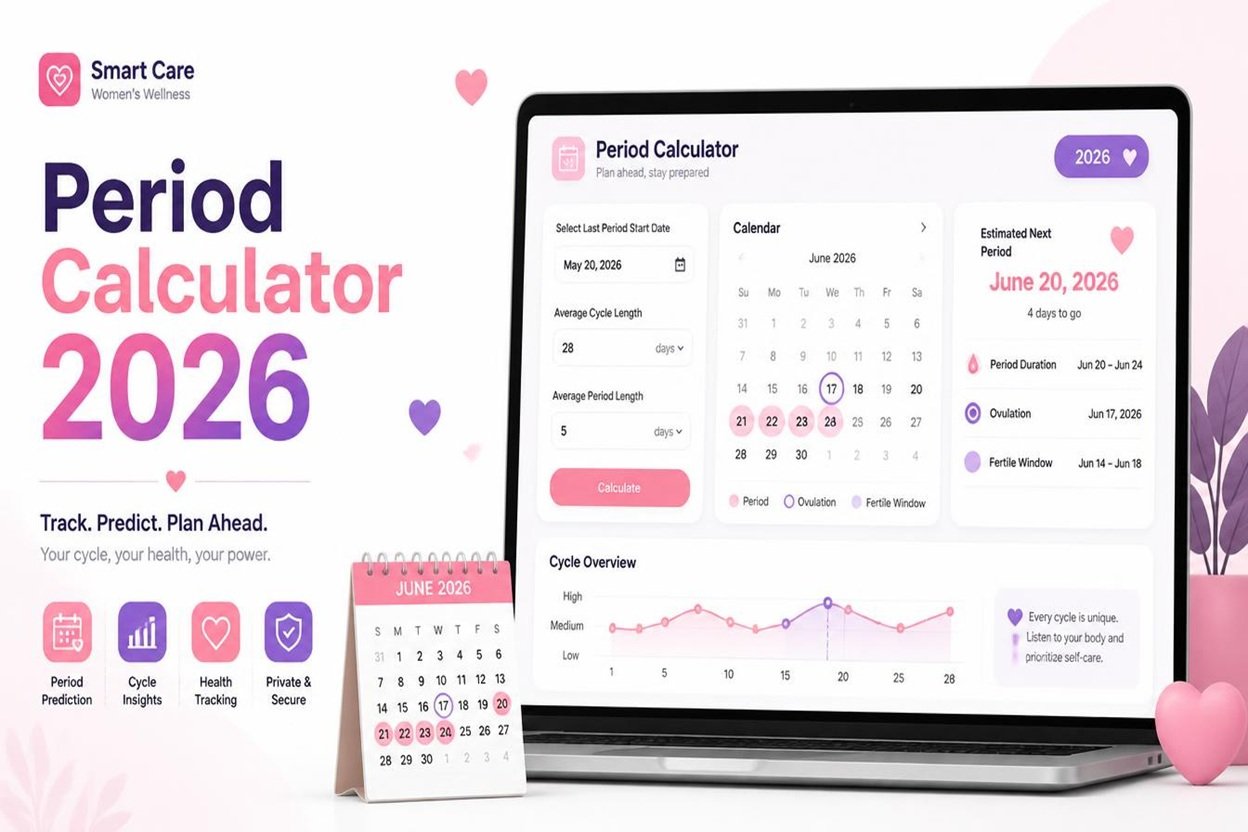
Period Calculator
Track your menstrual cycle, predict future periods, and understand your fertility window
Calculate Your Cycle
Your Cycle Overview
Cycle Calendar
Cycle History
Menstrual Phase
The menstrual phase is when you have your period. It typically lasts 3-7 days and marks the beginning of your cycle.
Follicular Phase
This phase starts on the first day of your period and lasts until ovulation. Your body prepares for ovulation during this time.
Ovulation Phase
Ovulation occurs when an egg is released from your ovary. This is your most fertile time, typically around day 14 of a 28-day cycle.
Luteal Phase
This phase lasts from ovulation until your next period. If pregnancy doesn’t occur, hormone levels drop, leading to your next period.
Fertile Window
Your fertile window includes the 5 days before ovulation and the day of ovulation. This is when you’re most likely to get pregnant.
Ovulation Signs
Common signs of ovulation include changes in cervical mucus, mild pelvic pain, increased libido, and a slight rise in basal body temperature.
Tracking Ovulation
You can track ovulation using calendar methods, ovulation predictor kits, basal body temperature charting, or monitoring cervical mucus.
Cycle Variations
Cycle length can vary from person to person and even month to month. Stress, illness, and lifestyle changes can affect your cycle.
Nutrition
Eat iron-rich foods during your period. Include calcium, magnesium, and vitamin B6 in your diet to help with PMS symptoms.
Exercise
Regular exercise can help reduce menstrual cramps and improve mood. Gentle activities like yoga and walking are beneficial.
Stress Management
High stress can affect your cycle. Practice relaxation techniques like meditation, deep breathing, or journaling.
Sleep
Prioritize quality sleep, especially during your period. Adequate rest helps regulate hormones and reduces fatigue.
Period Calculator:
Tracking your menstrual cycle can help you understand your body, plan ahead, and identify changes in your period pattern. A Period Calculator Tool makes this process simple by estimating your next period based on your previous cycle dates.
In 2026, online period calculators have become a convenient way to track menstrual cycles without complicated calculations. Whether you want to estimate your next period, understand your cycle length, or plan around an upcoming date, a period calculator can provide a quick estimate.
What Is a Period Calculator Tool?
A Period Calculator Tool is an online tool that estimates when your next menstrual period may begin. It usually requires two basic details: the first day of your last period and your average menstrual cycle length.
After entering this information, the calculator uses your cycle history to estimate your next period date. Some advanced tools may also estimate your fertile window and ovulation date.
A period calculator is designed to make cycle tracking easier and save you from manually counting calendar days.
How Does a Period Calculator Work?
Using a period calculator is generally very easy. The tool calculates your expected period based on your previous menstrual cycle.
For example, if your last period started on January 1 and your average cycle is 28 days, your next period may be expected around January 29.
The basic process is:
- Enter the first day of your last period.
- Enter your average cycle length.
- Click the calculate button.
- Check your estimated next period date.
The result is an estimate rather than a guaranteed date because menstrual cycles can naturally change from month to month.
Why Use a Period Calculator?
There are several reasons people use a menstrual cycle calculator. The biggest advantage is convenience. Instead of counting days manually, you can enter your information and receive an estimated date within seconds.
1. Predict Your Next Period
The main purpose of a period calculator is to estimate your next period. Knowing an approximate date can help you prepare for your menstrual cycle.
2. Track Your Menstrual Cycle
Regular tracking can help you understand your personal cycle pattern. You can compare your cycle length from one month to another and notice changes over time.
3. Estimate Your Fertile Window
Some period calculators provide an estimated fertile window based on your cycle information. This can help you better understand the different stages of your menstrual cycle.
4. Plan Ahead
Knowing your estimated period date can be useful when planning travel, vacations, sports activities, events, or other important plans.
5. Save Time
Manual calculations can be confusing, especially when your cycle length changes. A calculator performs the basic calculation automatically.
How to Calculate Your Next Period Manually
You do not necessarily need an online tool to estimate your next period. You can calculate it manually using your last period date and average cycle length.
For example:
Last period start date: March 1
Average cycle length: 28 days
Estimated next period: Around March 29
Simply count your average cycle length from the first day of your last period.
However, an online period calculator tool can make this process faster and easier, particularly when you want to track several cycles.
What Is a Normal Menstrual Cycle?
A menstrual cycle is counted from the first day of one period to the first day of the next period. Cycle length can vary between individuals and may also change from month to month.
Although a 28-day cycle is commonly used as an example, not everyone has a 28-day cycle. Your personal cycle may be shorter or longer.
Factors such as stress, lifestyle changes, sleep, weight changes, exercise, illness, hormonal changes, and other circumstances can affect menstrual timing.
For this reason, a period calculator should be treated as an estimation tool, not a medical diagnostic tool.
Period Calculator and Ovulation
Some online period calculators also estimate ovulation. Ovulation generally occurs around the middle of the menstrual cycle, but the exact timing can vary.
For people with regular cycles, an estimated ovulation date can provide a general idea of when ovulation may occur. However, calendar-based calculations cannot confirm that ovulation actually happened.
If you are trying to become pregnant or avoid pregnancy, do not rely solely on a period calculator for contraception or fertility decisions. Consider speaking with a qualified healthcare professional about more reliable methods.
Benefits of Using the Best Period Calculator in 2026
The best period calculator 2026 should be simple, fast, mobile-friendly, and easy to understand. A useful calculator should not require complicated information.
Important features may include:
- Simple date entry
- Cycle length calculation
- Estimated next period date
- Easy-to-read results
- Mobile-friendly design
- Quick calculations
- Privacy-conscious data handling
- Optional fertile-window estimates
A clean interface is especially important because users should be able to enter their information without confusion.
Is a Period Calculator Accurate?
A period calculator can provide a useful estimate, but it cannot predict your exact period date with complete accuracy.
Menstrual cycles are biological processes, and they can change naturally. If your cycles are irregular, the calculator’s estimate may be less accurate.
For better results, tracking your period for several months can give you a clearer idea of your average cycle length.
Remember that an online calculator does not replace professional medical advice.
Who Can Use a Period Calculator?
A menstrual period calculator can be useful for anyone who wants to track their menstrual cycle. It can help people understand their typical cycle pattern and prepare for upcoming periods.
It may be particularly useful for:
- People tracking regular periods
- People learning about their menstrual cycle
- People planning travel or activities
- People monitoring cycle changes
- People interested in understanding estimated fertile days
If your period suddenly becomes very irregular, extremely painful, unusually heavy, or changes significantly from your normal pattern, consider discussing the change with a healthcare professional.
Tips for More Accurate Period Predictions
For better estimates, keep track of the first day of each period rather than relying on memory.
Here are some simple tips:
Track consistently: Record your period start date every month.
Know your cycle length: Calculate your cycle length over several months to find your average.
Record changes: Note unusual changes, stress, illness, or lifestyle changes that may affect your cycle.
Update your information: If your average cycle length changes, update the calculator.
Use estimates carefully: Remember that calculated dates are predictions, not guarantees.
Period Calculator vs. Period Tracking App
A period calculator is usually designed for quick predictions, while a period tracking app may offer more detailed features.
A calculator may be better if you only want to estimate your next period quickly. An app may be more useful if you want to maintain a long-term record of symptoms, cycle length, mood, or other information.
The best option depends on your personal needs and how much information you want to track.
Final Thoughts
A Period Calculator Tool is a simple and convenient way to estimate your next menstrual period. By entering your last period date and average cycle length, you can quickly receive an estimated date without doing manual calculations.
The best period calculator in 2026 should be easy to use, accurate for basic calculations, mobile-friendly, and transparent about the fact that its results are estimates.
Regular cycle tracking can help you become more familiar with your menstrual pattern. However, menstrual cycles naturally vary, so calculator results should not be considered a medical diagnosis or a guaranteed prediction.
If you notice major or persistent changes in your menstrual cycle, consult a qualified healthcare professional for personalized advice.
Also checkout tools
Also visit payoff calculators at All payoff calculators
FAQ’S
1. What is a Period Calculator Tool?
A Period Calculator Tool is an online tool that estimates your next period date based on the first day of your last period and your average menstrual cycle length.
2. How accurate is a Period Calculator?
A period calculator provides an estimate, not an exact prediction. Its accuracy can vary depending on how regular your menstrual cycles are.
3. How do I calculate my next period?
Enter the first day of your last period and your average cycle length into the calculator. The tool will estimate when your next period may start.
4. Can a Period Calculator predict ovulation?
Some period calculators can estimate your ovulation date and fertile window. However, these are estimates and should not be considered a guaranteed indication of ovulation.
5. Can I use a Period Calculator if my periods are irregular?
Yes, you can use one, but the results may be less accurate when your cycle length varies significantly from month to month.

3 thoughts on “Period Calculator | Best Tool 2026”